A Year-End Policy Review, Starting with One Question
A year-end policy review built around one clear question helps separate what the review examined from what its evidence can reasonably support.
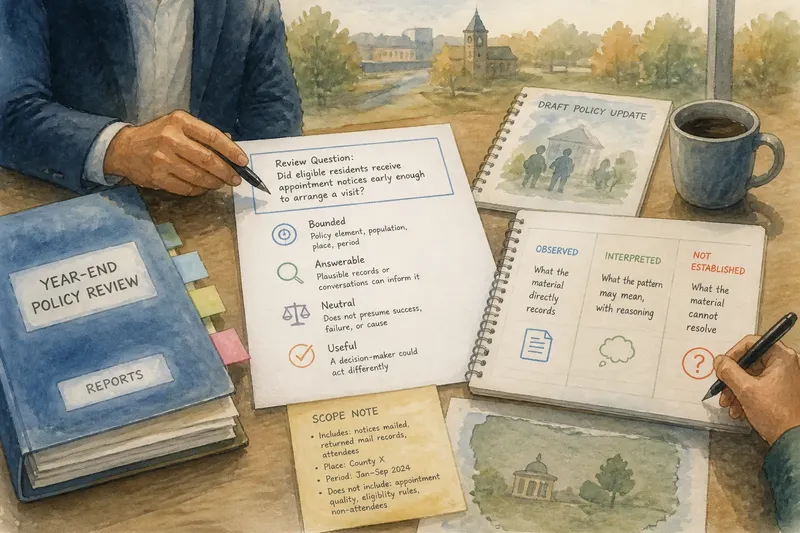
At a year-end meeting, a folder of reports sits beside a draft policy update, and someone asks whether the initiative worked. A useful year-end policy review begins by narrowing that question: what, exactly, was the review meant to examine? The answer gives the record a boundary before conclusions begin to spread beyond it.
Choose a question that can meet the record
A review question should point to an observable aspect of policy, not invite a verdict on the whole effort. “Did the program succeed?” bundles several matters together: who received the service, how it was delivered, what changed, and whether the change can be attributed to the policy.
A more workable question might be, “Did eligible residents receive appointment notices early enough to arrange a visit?” It names a group, a process, and an outcome that records or interviews may help illuminate. It does not assume that timely notice alone explains whether the policy achieved its broader aims.
Before settling on a question, check that it is:
- Bounded: It identifies the policy element, population, place, or period under review.
- Answerable: Plausible records or conversations can bear on it.
- Neutral: Its wording does not presume success, failure, or a preferred explanation.
- Useful: A decision-maker could act differently depending on the answer.
If the question contains several “and” clauses, it may be carrying more than one inquiry. Keep one central question for the review, then record related questions separately rather than quietly answering them along the way.
Write down what the question leaves out
A focused question is valuable partly because it excludes. If a review asks whether notices arrived in time, it does not, by itself, assess the quality of the appointments, the fairness of eligibility rules, or the policy’s effect on residents who never applied.
Make those limits visible in a short scope note. Name the policy component, the people and settings included, and the material examined. Also name what the review does not cover. This is not a disclaimer added after the findings; it is part of the design that keeps the eventual answer honest.
Imagine a county review asks whether mailed appointment notices reached eligible residents before their scheduled visits. The team examines returned-mail records and interviews a small group of residents who attended. It can describe patterns in those materials and identify questions for follow-up, but it cannot claim to represent people who did not attend or establish that the notice process caused attendance.
That distinction matters because administrative records often describe contact with an institution more clearly than they describe people outside it. A neat file is not a complete picture of the public affected by a policy.
Keep observations separate from conclusions
During the review, use three plain labels in working notes: observed, interpreted, and not established. The labels act like separate trays on a desk: they keep unlike things from being stacked together.
- Observed: What the reviewed material directly records, such as a notice date or a documented contact.
- Interpreted: What the team thinks the pattern may mean, with the reasoning stated.
- Not established: What the available material cannot resolve, including alternative explanations.
For instance, a set of files may show that some notices were returned after the appointment date. That observation supports concern about delivery timing. It does not establish whether the address was outdated, the mailing was delayed, or the recipient had another way to learn about the appointment.
Keep the source close to each observation. A dated record, interview note, or case-management entry should be identifiable in the working file, so another reader can see where a statement came from. If sources disagree, preserve the disagreement rather than smoothing it into a single account.
How should the review answer its question?
What belongs in the review question?
Include the policy element and the outcome or process you want to understand, along with a relevant group or setting. Use language that leaves room for an unfavorable or mixed answer.
How can the team handle missing information?
Describe which information is absent and how that absence may shape the answer. Do not treat missing records as proof that an event did or did not occur.
When should a finding stay tentative?
Keep it tentative when the evidence is incomplete, sources conflict, or more than one explanation fits the observed pattern. State what further information could help distinguish those explanations.
What should the review do with a broader concern?
Record it as a follow-up question rather than folding it into an answer the review was not designed to provide. A separate inquiry may need different records, participants, or expertise.
Make the ending useful without making it larger
Close the review by returning to the original question in its own terms. Give the best-supported answer, name the evidence behind it, and state the boundary that matters most. If the answer is partial, say which part is supported and which remains unresolved.
Then connect the finding to a proportionate next decision. A review might recommend checking address-update procedures, clarifying how returned mail is recorded, or examining whether residents have another reliable way to receive notice. These are possible responses to a finding, not proof that any one change will solve the underlying issue.
Keep recommendations distinct from conclusions. A conclusion describes what the review can support; a recommendation proposes what an institution might do next. That separation gives decision-makers room to weigh operational constraints and public priorities without mistaking a proposed action for an established result.
A year-end policy review earns trust by showing its edges as clearly as its findings. Keep the question, scope, evidence, and limits together in the final record, and a reader can judge not only the answer, but also how far that answer should travel.