The Definition That Decides What a Policy Covers
Policy definitions set who qualifies and what counts. Learn to spot ambiguous terms, trace their practical effects, and clarify boundaries before decisions diverge.

A clerk reviewing a grant application pauses at the phrase “community organization.” The applicant is a volunteer-run neighborhood group; the policy never says whether groups without formal registration qualify. That small gap in the definition of a policy can decide whether the application moves forward, even though the policy’s stated purpose is clear.
Definitions are not decoration at the start of a document. They set the boundary between cases a policy covers and those it leaves outside, and they shape the routine decisions made by staff, applicants, contractors, and reviewers. A careful definition cannot resolve every hard case, but it can make the intended boundary visible and expose where judgment is still required.
Policy definitions draw the working boundary
A policy may define a person, place, activity, document, or event. Each definition turns a general intention into a category that can be recognized in practice. “Small business,” for example, might refer to legal form, ownership, staffing, location, or some combination; each choice includes some applicants and excludes others.
The boundary often matters most where the policy’s purpose and its operating language meet. A program intended to help residents facing a particular barrier may use “resident” as its eligibility term. If the document does not clarify whether temporary residents, people in transitional housing, or people without a conventional address count, different offices may interpret the same purpose differently.
Think of a definition like a doorframe: it gives a passage a shape, but the shape determines who can pass through without difficulty. The analogy has limits—policy boundaries are interpreted, not built from wood—but it helps make the consequence concrete. A term that appears neutral can still organize access, duties, and staff workload.
Ambiguity appears at the edge of ordinary cases
Writers often notice vague language when a term has several familiar meanings. The more revealing test is whether two reasonable people can classify the same borderline case differently. “Local supplier” may sound straightforward until a company has a local office but ships goods from elsewhere, or a locally owned firm operates across a wider region.
Look for words that quietly carry a decision: “eligible,” “regular,” “accessible,” “household,” “public,” “immediate,” and “substantial.” Also examine phrases such as “including,” “as appropriate,” and “other similar cases.” These can leave room for sensible judgment, but they may also conceal who is empowered to decide and what considerations should guide that decision.
Say a fictional city policy offers translation support to “community events.” Imagine its drafters intend to include gatherings organized by schools and tenant groups, not only events open to every resident. If staff treat “community” as meaning open to the general public, the expected observable result is that some intended organizers are turned away or asked to provide extra proof. Naming the covered organizers—or stating the public-access criterion—would make the boundary easier to apply.
Trace a definition through the decision it controls
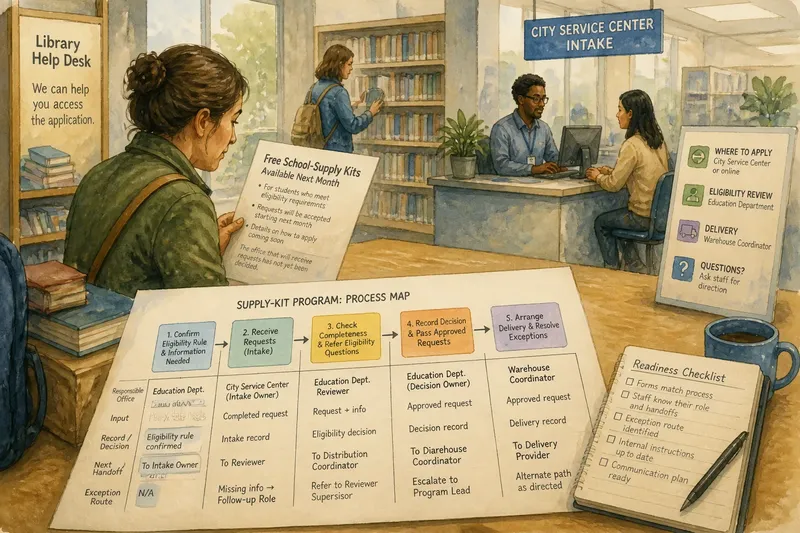
To understand what a term does, follow it through the policy’s ordinary workflow. Find where a person or case first has to meet the definition, then track what happens after that classification: access to a service, an obligation to comply, a deadline, a referral, or a review. A definition can seem minor in the opening section yet determine the outcome several pages later.
Use a short boundary review during drafting or revision:
- Locate the operative term. Identify the word or phrase that determines coverage, eligibility, responsibility, or an exception.
- State the intended category plainly. Describe, in ordinary language, the people, places, activities, or materials meant to fall inside it.
- Try a borderline case. Choose a plausible case near the boundary and ask whether two staff members would classify it the same way.
- Follow the practical consequence. Record what the classification changes for the person affected and for the office handling the case.
- Find the decision-maker. Check whether the text says who resolves an uncertain case and what reasons they may consider.
- Revise only what needs clarity. Add a criterion, an example, or a defined exception when it resolves a real ambiguity; avoid adding detail that does not affect application.
This review is not a demand to make every category exhaustive. Trying to list every possible situation can make a policy brittle and unreadable. The aim is to reveal the choices already embedded in the term, then decide which should be stated and which should remain guided discretion.
Choose the right kind of boundary
Some definitions work best as a clear threshold: an applicant must meet a named condition. Others need a list of included cases, especially when readers might otherwise assume the category is narrower than intended. A third option is a principle with a controlled exception, such as a general rule paired with authority to consider unusual circumstances.
Each approach has a tradeoff. A crisp threshold can make decisions more consistent but exclude cases that share the policy’s underlying need. An open-ended standard can accommodate unusual circumstances but may produce different judgments across offices. An illustrative list can orient readers without closing the category, provided the policy makes clear whether the examples are exhaustive.
Where the boundary depends on evidence, distinguish the category from the proof used to establish it. A policy might cover people who live in a service area, while accepting several forms of evidence rather than treating one document as the definition itself. Otherwise, an administrative shortcut can quietly become a narrower eligibility rule.
The operative language should also match the decision’s scale. A definition that assigns a significant benefit or burden deserves more precision than a term used only for descriptive context. If the wording affects legal rights, statutory duties, or sensitive personal information, policy staff should consult the appropriate legal or subject-matter professional. Where the right answer depends on a label, manufacturer instructions, or local rules, check the relevant authority rather than assuming the policy text settles it.
Which questions reveal a weak boundary?
Who is left out by this definition?
Ask which plausible people, organizations, or activities fail the stated test, including those the policy’s purpose appears to concern. If the exclusions are intentional, the text can make that choice legible; if not, the boundary may need revision.
Can two staff members classify the same case differently?
Present a borderline case without telling readers the intended answer and ask them to explain their classification. Different answers point to a missing criterion, a term with competing meanings, or discretion that needs clearer guidance.
What evidence will a person have to provide?
Check whether the policy’s category implicitly assumes a document, address, formal status, or record that some covered people may not have. If evidence is necessary, identify acceptable alternatives or explain how the office can assess the case fairly.
Who can make an exception, and on what basis?
An exception can preserve room for unusual circumstances, but only if the policy makes its authority and relevant considerations understandable. Without that, exceptions may depend on which staff member receives the case rather than on a defensible policy judgment.
Keep the definition connected to the policy’s purpose
After revising a term, read it alongside the policy’s stated purpose and the decisions it governs. Ask whether the covered group still reflects the problem the policy is meant to address, and whether the criteria create a burden unrelated to that aim. This is a focused check on scope, not a substitute for a broader assessment of policy effects.
Definitions also need a clear home. Put central terms where readers can find them, use them consistently throughout the document, and avoid quietly changing their meaning in forms or staff guidance. If an operational form asks for information that the policy does not make relevant, the form may be imposing a boundary the policy never approved.
When a definition remains deliberately open, pair it with a usable decision standard. Staff need to know what features matter, what reasons should not drive the decision, and where to send an unresolved case. That guidance preserves judgment while making it possible to explain why similar cases were treated alike or why a meaningful difference changed the outcome.
A policy definition deserves attention wherever a single word changes who receives a service, carries a duty, or gets considered for an exception. For a practical boundary check, follow the definition from its first use to the decision it controls, then test one plausible edge case. The result is not perfect certainty; it is a clearer account of who the policy covers and where human judgment begins.