An Announcement Is Not an Implementation Plan
An announcement is not an implementation plan: assign ownership, connect tasks, and prepare the work behind a public decision before inviting people to act.
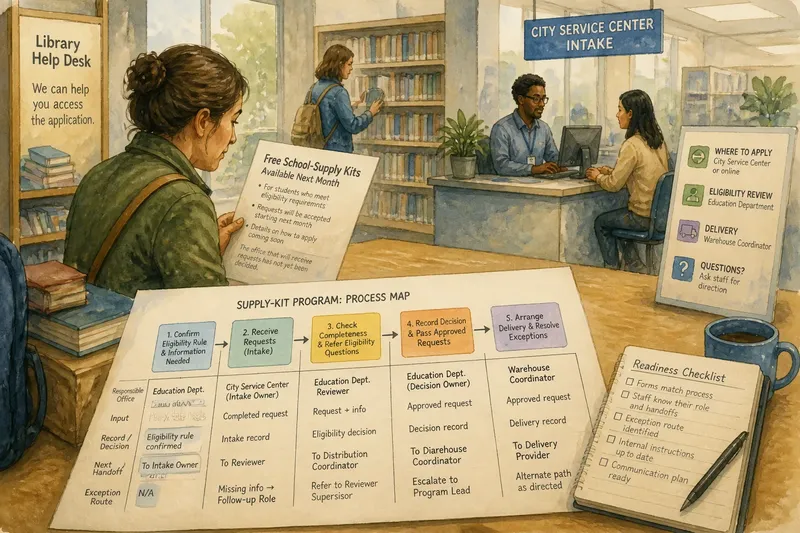
At a neighborhood library, a parent reads a city notice about free school-supply kits. The announcement says the kits will be available next month, but no one has decided which office will receive requests. An implementation plan connects that public promise to the work needed to deliver it.
Policy reaches residents through the actions an agency asks them to take, but this is not simply a matter of writing clearer notices. The central implementation question is how a decision becomes coordinated work: which office owns each task, where one task hands off to another, and how staff resolve exceptions. Public communication can describe that arrangement, but it cannot replace it.
An implementation plan connects authority to assigned work
Imagine the city council has approved a supply-kit program for students whose households meet an eligibility rule. Approval settles the policy direction, but not the operating decisions: who checks eligibility, what information is needed, and which office arranges delivery.
A useful plan makes those decisions visible. It can be a process map, a responsibility table, or a short operations document, provided staff can see what happens next and who is accountable for it. A relay race offers a plain analogy: assigning runners is not enough; each handoff has to be clear.
The plan should distinguish the authority to decide from the responsibility to carry out a decision. The education department might interpret eligibility rules, while a service center receives requests and a warehouse coordinator organizes distribution. Naming the participating organizations without assigning their tasks leaves the handoffs unresolved.
Map the work from approval through delivery
Start with the sequence of work rather than a list of departments. For the invented supply-kit program, the team could map these tasks:
- Confirm the eligibility rule and the information needed to apply.
- Receive requests through the chosen intake route.
- Check each request for completeness and refer eligibility questions to an authorized reviewer.
- Record the decision and pass approved requests to the distribution coordinator.
- Arrange delivery and resolve requests that cannot follow the usual route.
For each task, identify the responsible office, the information it needs, the record it creates, and the next handoff. Also name the role authorized to settle a disagreement or approve an exception. This keeps routine work from depending on informal guesses about who is allowed to decide.
Say the service center receives a request with no school listed. The plan directs staff to record the missing information and send the request to the role responsible for follow-up; it also identifies who can proceed if the family cannot supply the usual school record. The expected result is a clear next action and an identified decision-maker, rather than a request circulating between offices.
Make the process usable across offices
In the hypothetical program, the team selects the city service center as the intake owner. Library branches and schools can provide paper forms, but they send completed forms into the same review process as online submissions. That arrangement gives staff a defined boundary: they can help residents access the form without making eligibility decisions they are not authorized to make.
Before opening, the team can walk a sample request through the process. This planning exercise is a way to check whether forms, records, and handoffs fit together; it is not proof that the live service will work without difficulty. If a form asks for information that the assigned reviewer does not use, the team can remove or justify that field before it becomes part of routine work.
For example, imagine a family submits a paper form at a library and leaves the school field blank. The service center records the omission, sends the request to the assigned follow-up role, and routes the completed information to the education department for review. The observable result is that staff can identify where the request stands and what action is due, without asking the library to make an unauthorized eligibility judgment.
Use public communication to explain the operating arrangement
Once responsibilities and handoffs are settled, the city can announce where requests go, which office reviews eligibility, and what to expect if information is missing. A program page can explain details that do not fit in a short notice, while a staff reference sheet can show library and school employees where to direct operational questions.
The goal is not to make every message identical. It is to keep the underlying instructions compatible: each version should reflect the same intake route, decision authority, and division of work. If a family asks about a change of school, for instance, staff need an approved route to the person authorized to interpret the rule, not an improvised answer at a counter.
Operational communication also includes coordination among staff. The program lead should make sure that a change to an eligibility rule or handoff reaches the offices that act on it, and that outdated forms and internal instructions are replaced. This is different from sending residents status messages; it is about keeping the machinery aligned when the process changes.
Which implementation decisions should be settled first?
Who should own each task?
Name the office responsible for doing the work and the role authorized to resolve exceptions. If two offices share a task, specify which one acts first and who accepts the handoff.
What should a process map include?
Show each task, its input, the responsible role, the record or decision it produces, and the next handoff. Include an exception route so staff know where unusual requests go.
How can teams prepare for a process change?
Identify who can approve the change and which forms, internal instructions, or staff arrangements it affects. Then assign responsibility for updating those materials and informing the offices that carry out the work.
What signals that a handoff needs attention?
Repeated referrals between offices, requests paused for unclear reasons, or staff unsure who can make a decision are signs to inspect the process. The program lead can trace where responsibility or information stopped moving and revise that handoff.
Check operational readiness before opening the program
Before the city invites families to apply, the program lead can review the plan against the actual work. Each check should lead to a decision, not merely a box marked complete:
- Decision authority: Check whether the eligibility rule and exception authority are recorded. If either is unclear, then assign an authorized decision-maker before opening; otherwise, brief the reviewers on the agreed rule.
- Task ownership: Check whether every task has a named responsible office. If any task has no owner, then assign one or remove that task from the launch process; otherwise, confirm the handoffs with the listed offices.
- Intake route: Check whether paper and online requests reach the same review process. If a route bypasses the assigned intake owner, then revise the route or pause that option; otherwise, document who receives and records each request.
- Required information: Check whether reviewers use each field on the form. If a field has no stated purpose, then remove it or identify the decision it supports; otherwise, make sure the responsible office can access the information.
- Exception handling: Check whether staff know where unusual or incomplete requests go. If no role can resolve them, then designate one before launch; otherwise, give staff the approved referral instructions.
- Staff instructions: Check whether schools and libraries have current guidance on what they do and do not decide. If their instructions conflict with the operating plan, then replace or correct them; otherwise, confirm that staff know the responsible contact for operational questions.
- Work capacity: Check whether the offices assigned to intake, review, and distribution can take on the planned tasks. If an office cannot accept its part, then change the assignment or adjust the opening plan; otherwise, confirm that each handoff has an available owner.
If a core responsibility remains unassigned, the city can delay opening or limit the launch to the parts that are ready. That is an operational decision about whether the proposed process can be carried out, not a substitute for explaining the program to residents.
Keep ownership visible as implementation develops
In the invented case, the city proceeds once the service center, education department, schools, and libraries have agreed on their respective tasks. The plan does not eliminate every unusual request, but it gives staff a shared way to route decisions and locate responsibility when work stalls.
For anyone asking how to create an implementation plan, a practical starting point is to trace one ordinary request from its first action to delivery. At each handoff, name the office that acts next, the information it needs, and the person authorized to resolve an exception.
Keep that map current as duties or rules change. A plan is useful not because it predicts every complication, but because it lets staff find the right owner and make the next decision without rebuilding the process from memory.