From Noticeboard to Online Form: The Changing Shape of Public Consultation
Public consultation formats shape what people see and can say. Learn how to match notices, meetings, and forms to the decision and the views it needs.

A paper notice on a library board gives a passerby a date, a place, and perhaps a phone number. A consultation webpage can put a map, technical documents, and a response form in front of the same reader. Public consultation formats shape not only where people encounter a proposal, but also what they are able to tell decision-makers.
It is tempting to treat a notice, meeting, mailed comment, and online form as interchangeable ways to collect input. They are not. Each format frames the question differently, and that affects the kind of evidence or perspective a participant can offer.
Each format frames the decision differently
A poster can announce a proposal, but it cannot carry the texture of a public conversation. A meeting lets people hear questions and replies, yet an agenda and microphone can privilege short, confident remarks. A written submission allows more time to explain a concern, while asking the participant to shape that explanation alone.
Online forms add another kind of framing. A multiple-choice question may make trade-offs easy to compare, but it can imply that the listed options are the only legitimate ones. An open comment box leaves more room for an unexpected concern, though it offers little guidance to someone unsure what information would help.
Choose formats by the kind of contribution the decision needs. If officials need to compare reactions to distinct options, a focused question may help. If the issue could affect people in ways the agency has not anticipated, leave room for a response outside those categories.
Meeting formats shape whose voices enter the record
Public meetings make disagreement visible and can reveal how participants respond to one another. But speaking before a room is not equally comfortable or practical for everyone, and a meeting record may preserve a brief statement without the context that gave it meaning.
Written comments have different strengths and limits. A letter or email gives a participant space to explain a chain of reasoning, but people who are less comfortable writing may struggle to turn a lived concern into a polished submission. A structured form can help by asking a clear question, provided it does not force every response into a preset category.
For a proposal where both public discussion and individual reflection matter, combine formats with distinct purposes. A meeting can surface questions and points of disagreement; a later written period can give people time to respond to the options. The record should distinguish those kinds of input instead of treating them as identical units.
Online forms shape the answers they receive
The order and wording of a form influence how a participant interprets the task. If a page opens with a long technical report, readers may not reach the question. If it opens with a leading prompt, respondents may take the agency’s framing as a boundary on what can be said.
Before asking for a view, state what decision is under consideration and what remains open. Use plain wording, explain necessary terms, and separate questions about distinct issues. A participant should be able to tell whether the agency wants a preference, a reason, information about an effect, or a different option.
Keep a route for comments that do not fit the form’s structure. This matters especially when the proposal may affect people in ways that are not obvious from the agency’s initial categories. A useful form can guide responses without pretending to anticipate every relevant concern.
Access changes who can contribute and how
An online process may suit someone with a reliable connection, a suitable device, and confidence reading material on screen. It can exclude someone using a shared phone, assistive technology, or a language not available on the page. Those are not merely technical inconveniences: they can change which experiences appear in the public record.
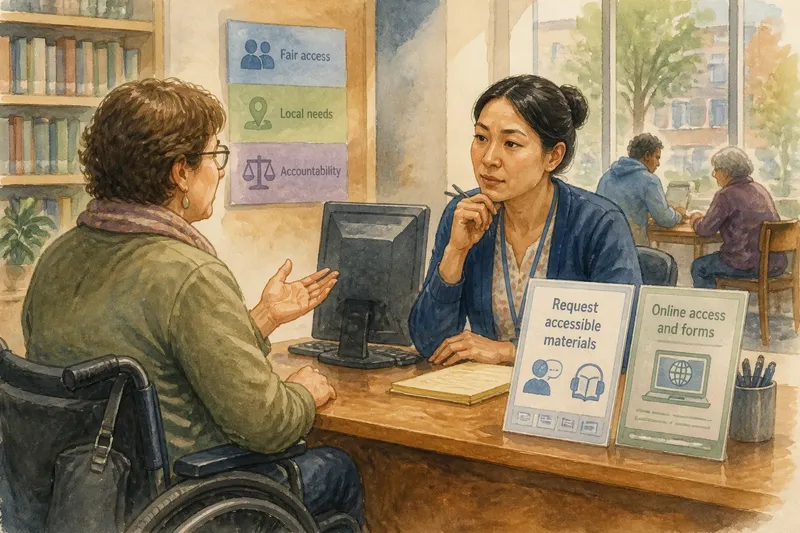
Offer meaningful alternatives, not just a paper copy of a digital form. A phone contact, printed materials, an in-person option, and a stated way to request an accessible format can address different barriers. Where interpretation or translation is relevant, explain how to request it in time to participate.
Consider whether each route presents the same essential information and asks for input that can inform the same decision. A paper response should not leave someone without a map or explanation available online. An in-person session should give participants a way to submit a view that cannot be expressed within the meeting agenda.
How should you choose a consultation format?
When is an online form a good fit?
A form can work well when the question is focused and participants need time to consider it. Keep a free-text route if the issue may prompt concerns outside the listed options.
When should a public meeting be included?
A meeting can help when people need to hear explanations, ask follow-up questions, or understand points of disagreement. Provide a way to contribute without speaking aloud so the meeting does not become the only route into the record.
What should a consultation ask people to contribute?
Tell participants whether the agency wants preferences, reasons, information about effects, or alternatives. If a question asks for a choice, clarify whether the options are complete or whether other proposals are welcome.
How can people take part without reliable internet?
Offer a paper or in-person route and state how to obtain the same basic information in that format. If phone submissions are accepted, explain how staff will record them so participants know what will enter the consultation record.
Review the format against the decision it serves
Say you are preparing a consultation about changes to a public square, and the invented starting point is a draft that offers three seating layouts in an online form. The agency wants to compare preferences but also needs to learn about access concerns it may have missed.
First, keep the three options as a focused question so respondents can compare the layouts. Next, add an open prompt asking what effect the draft might have on someone’s use of the square. Then offer the map and explanation in print at the library and accept paper comments there, so a person without internet can respond to the same proposal. The expected observable result is a record containing both comparable preferences and concerns that do not fit the three layouts; the tradeoff is that staff must review open comments separately rather than treating every response as a simple selection.
For another proposal, check each format against these decisions:
- Check whether the invitation states the decision and the people likely to be affected; if it does, use that wording consistently across channels, but if it does not, clarify the decision before publishing.
- Check whether the central question is understandable without opening technical files; if it is, link the files as supporting detail, but if it is not, add a plain-language explanation before inviting responses.
- Check whether the response method fits the input sought; if a comparison is needed, use a focused question, but if unforeseen concerns matter, include an open response route.
- Check whether people can contribute without attending or speaking at a meeting; if they can, keep that route visible, but if they cannot, add a written or remote alternative.
- Check whether the proposal and essential context are available to people who cannot use the online page; if they are, state where to find them, but if they are not, provide print or another accessible route.
- Check whether each response route feeds into a record that decision-makers will consider; if it does, explain how input will be handled, but if it does not, revise the process before collecting comments.
- Check whether participants can understand how their input is represented in the eventual account; if they can, describe that reporting process, but if they cannot, plan a clear account of themes and unresolved points.
Public consultation works better when formats are chosen for the contributions they can support, not simply because they are familiar or easy to administer. Like choosing a container for a particular tool, the form should make the contents accessible without forcing them into an unsuitable shape.
For public consultation, the useful question is not only who responded, but what the chosen format allowed them to express. A decision record becomes more informative when it preserves the distinction between a stated preference, an explanation, and a concern the original question did not anticipate.